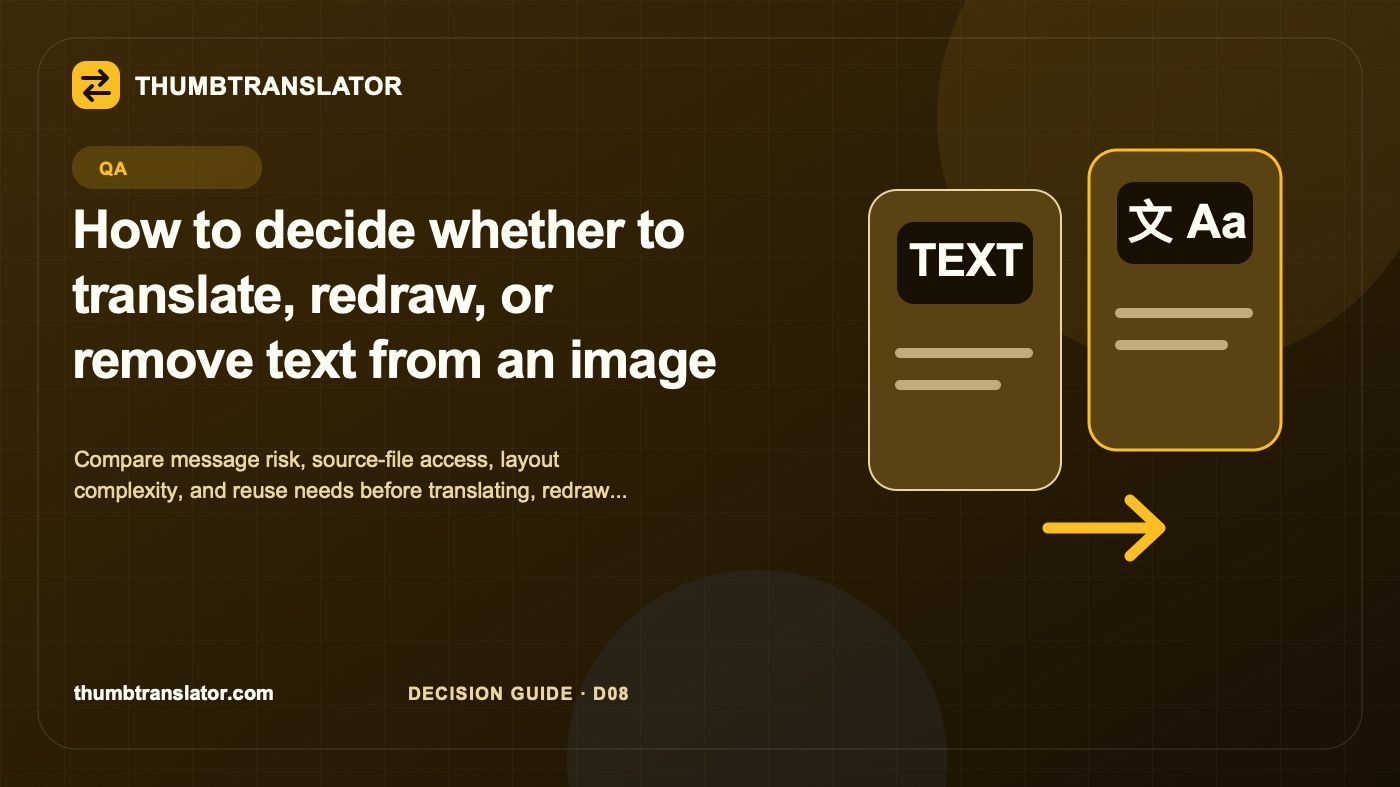
How to decide whether to translate, redraw, or remove text from an image
Compare message risk, source-file access, layout complexity, and reuse needs before translating, redrawing, or removing text from an image.
Written by
ThumbTranslator Team
Practical guidance for translating thumbnail and product-image text while protecting meaning, layout, and review quality.
Choose between translation, manual redraw, and text removal by examining the asset, not by assuming one method is always better. Check the message risk, whether editable source files exist, how tightly text is tied to the design, and how often the asset will be reused. Then record the choice, its limits, and the reviewer who approved it.
Translation keeps text inside the graphic. Redrawing gives a designer direct control over the text area. Removing text shifts the message out of the image or drops it entirely. Each option can be reasonable, and each can fail when it is used for the wrong job.
Classify the image and message
Start by listing what the embedded text does. A headline carries a different risk from a model number, warning, price, or instruction. Ordinary marketing copy may allow adaptation. Factual or sensitive text needs an approved source and a clear owner.
Also classify the visual structure. Is the text on a clean block of color, over a patterned background, wrapped around a subject, or integrated into an object? Does the image contain one short phrase or many small regions? The more tightly text and artwork interact, the more review the result will need.
Record expected reuse. A one-time social graphic may justify a different workflow from an evergreen asset that will be updated for several markets. Do not turn that observation into an automatic rule. Reuse is one factor among message risk, source access, and design complexity.
Use a simple intake:
| Factor | Low concern | Higher concern |
|---|---|---|
| Message | Short, ordinary copy with an approved translation | Names, numbers, claims, warnings, or instructions |
| Layout | Text has clear space and simple hierarchy | Text overlaps subjects, effects, or multiple regions |
| Image detail | Background is easy to inspect | Fine product, face, logo, or patterned details surround text |
| Reuse | One controlled version | Many markets, revisions, or long-lived assets |
This intake does not choose the method by itself. It makes the assumptions visible before production begins.
Check source-file availability
Editable source files change the available choices. If the team has the original design with text layers, a designer can replace approved copy while keeping direct control over fonts, positions, effects, and background. That can make manual redraw practical, but it does not remove the need for language and fact review.
A flattened image does not contain editable text layers simply because words are visible. Font identification, background repair, and text placement may need reconstruction. If exact brand typography matters and the font file is missing, record that gap instead of promising an exact match.
Check permissions too. The team should know whether it may edit, translate, and republish the source. A technically easy change is not appropriate if rights or approval are unclear.
Record which assets are available:
- editable design file and linked fonts;
- approved source copy;
- approved target copy;
- original high-resolution image;
- brand rules and reviewer contacts;
- authoritative source for factual tokens.
Missing items do not always stop the project, but they affect risk and may make one method unsuitable.
Estimate translation and layout risk
Review the target copy before rendering it into the image. Longer phrases, different line breaks, unfamiliar scripts, and changes in reading order can alter hierarchy. The reviewer should decide how much adaptation is allowed and which parts of the composition must remain untouched.
Separate risks into language, factual, and visual groups. Language risk covers meaning, tone, omissions, and added wording. Factual risk covers names, codes, numbers, dates, units, and claims. Visual risk covers readability, spacing, effects, subject overlap, and changes to nearby image details.
Estimate risk with questions, not invented scores:
- Can a fluent reviewer approve the target copy?
- Does a fact owner exist for sensitive tokens?
- Is there enough room for the approved wording?
- Would damaged image detail misrepresent the subject?
- Can the team inspect and revise the result before use?
If a critical answer is unknown, pause. Do not disguise missing evidence with a confidence number. The decision should become more conservative as the cost of an undetected error rises.
Compare translation, redraw, and text removal
Use a neutral table to compare the work each method requires. This is not a ranking and does not claim measured speed, cost, or quality.
| Method | Fits when | Requires | Stop when |
|---|---|---|---|
| Translate inside the image | A reviewed target phrase should remain embedded and the result can be inspected carefully | Approved copy, language review, visual QA, factual check | Meaning is uncertain, detail damage is unsafe, or the layout cannot hold the copy |
| Redraw the text area | Editable assets or design resources allow deliberate placement and styling | Designer, approved copy, source assets, final language and fact review | Required assets or authority are missing, or redraw changes protected artwork |
| Remove text | The message can move to surrounding page copy or is not required in the image | Approval to remove it, background repair, accessible surrounding content | Embedded text is required for identification, instruction, or another approved purpose |
Translation may reduce manual reconstruction in some cases, but do not claim a time saving without a comparison from the actual workflow. Redraw can offer more control when source assets exist, but it still needs review. Text removal can simplify a graphic only when the message remains available where the reader needs it.
Hybrid workflows are possible. A team may translate ordinary copy, manually redraw a critical label, and move a long explanation outside the image. Record each part separately so the final review covers the whole message.
Document the decision
Finish with a short decision record that another reviewer can understand. Note the asset, market, source-file status, message risk, chosen method, rejected alternatives, owner, reviewers, and unresolved limitations.
Use three decision states:
Proceedwhen the method has the needed source, permissions, owners, and review path.Revise planwhen a different copy length, source export, or method would reduce a known risk.Stopwhen meaning, facts, rights, or image integrity cannot be verified.
Set a recheck trigger. A new price, updated model, changed claim, different market, or revised design may invalidate the old decision. Reusing the decision without checking its assumptions can return an outdated asset to production.
Preserve rejected options and reasons. That record prevents the team from repeating the same debate and shows which missing evidence could change the choice later.
The right method is the one whose risks, source requirements, and review steps the team can actually manage for that asset. If those conditions are not met, the safe decision is to pause rather than publish an unverified graphic.
Related posts
Insights, updates and stories from our team